Commenting On Other Channels In Your Niche: Where Participation Ends And Spam Begins
There is a growth tactic that circulates in every creator community: spend twenty minutes a day commenting on bigger channels in your niche, and people will click your name to see who you are. It is usually described as free advertising.
The description is what makes it dangerous. Framed as advertising, it turns into something YouTube’s rules call spam. Framed as participation, it is one of the few genuinely useful things a small channel can do. Same activity, same twenty minutes, and the difference is entirely in the intent – which, awkwardly for anyone hoping otherwise, is visible in the comment itself.
I have been making YouTube content since 2017 and I do this, deliberately and slowly, in every niche I work in. Here is where the line sits.
Why the comment section of another channel is worth your time
YouTube is not only a video library. Underneath the videos in most established niches there is an ongoing conversation, and a lot of people read it. Some read it before watching. Some read it instead of watching. In technical and hobby niches the comments are frequently better than the video.
If you are consistently useful in that conversation, three things follow. A few people click your name out of curiosity, which is the part everyone focuses on. You learn what the audience for your topic is actually confused about, which is more valuable and never mentioned. And you become a recognisable name to a small group of regulars, which is how a channel gets its first genuine audience rather than its first hundred passing views.
That last one takes months. Everyone who sells this as a tactic skips that sentence.
Where it becomes spam
YouTube’s spam and deceptive practices policy covers comments explicitly. Repetitive comments, comments whose purpose is to drive traffic to something else, and mass or automated commenting are all treated as spam. Comments can be removed, and accounts that keep doing it can lose the ability to comment or worse.
In practice, four things put you on the wrong side of that line.
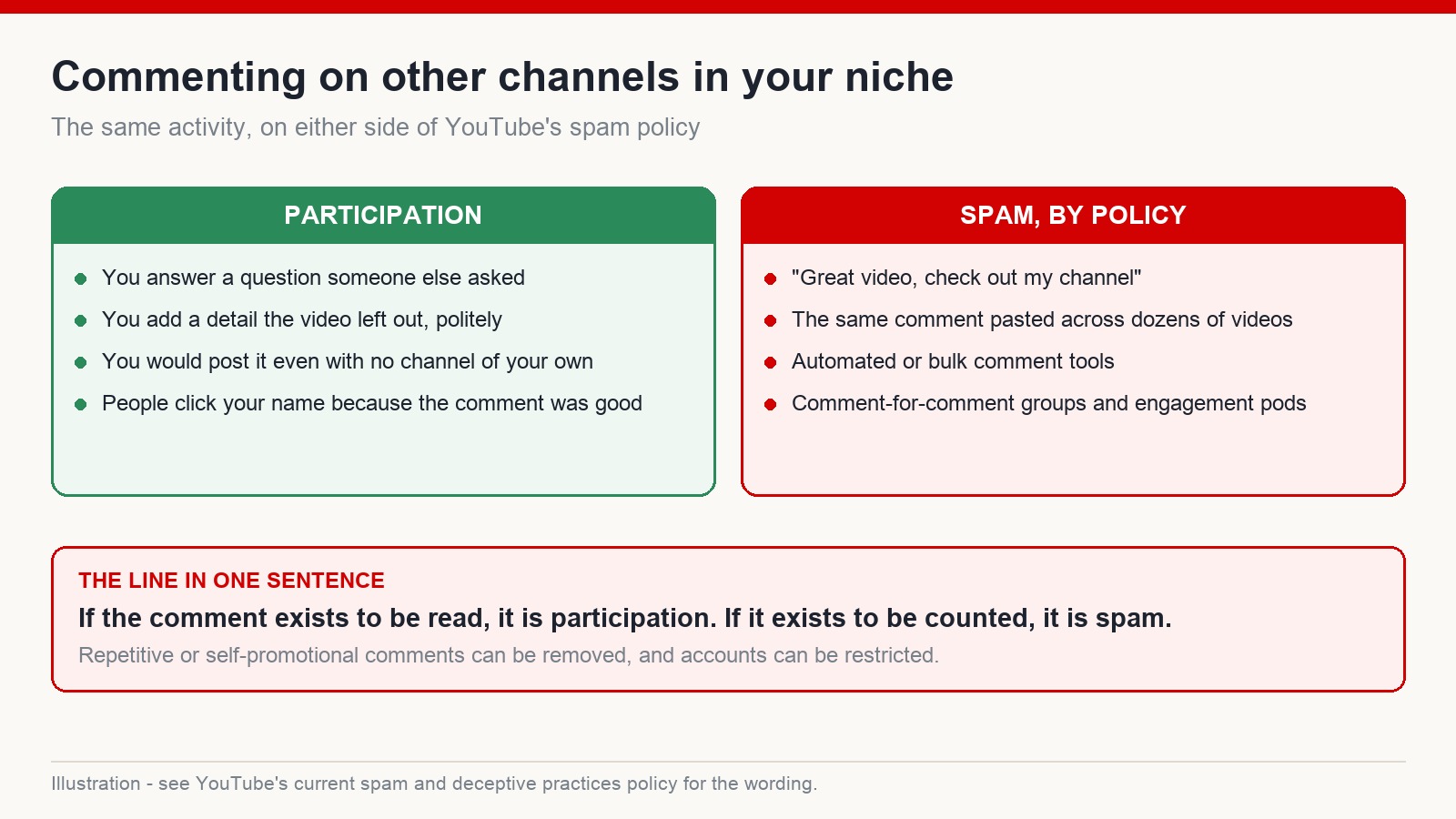
“Great video, check out my channel.” The most common version, and the one nobody clicks. It contributes nothing to the conversation and announces exactly what it is.
The same comment pasted everywhere. Even a thoughtful comment becomes spam when it is the thirtieth identical copy. Repetition is the signal.
Automated or bulk commenting tools. There is a small industry selling these. They exist to produce comment counts, which is precisely why they fall under the policy.
Comment-for-comment groups and engagement pods. Twenty creators agreeing to comment on each other’s uploads is fake engagement – interactions that did not come from people with genuine interest. Careful organisation does not change what it is.
There is a fifth variant worth naming because it is often taught as clever: using your own channel to comment on rivals’ videos specifically to divert their viewers. When the comment exists to extract traffic rather than to say something, it is self-promotional commenting whatever tone it is written in, and readers spot it faster than any system does.
The test that settles it
One question does all the work: if the comment exists to be read, it is participation; if it exists to be counted, it is spam.
A second, more uncomfortable version: would you post this comment if you had no channel at all? If the answer is no, do not post it. That single filter removes essentially every comment that would have got you into trouble, and it removes them for the right reason rather than out of fear of enforcement.
How to do it properly
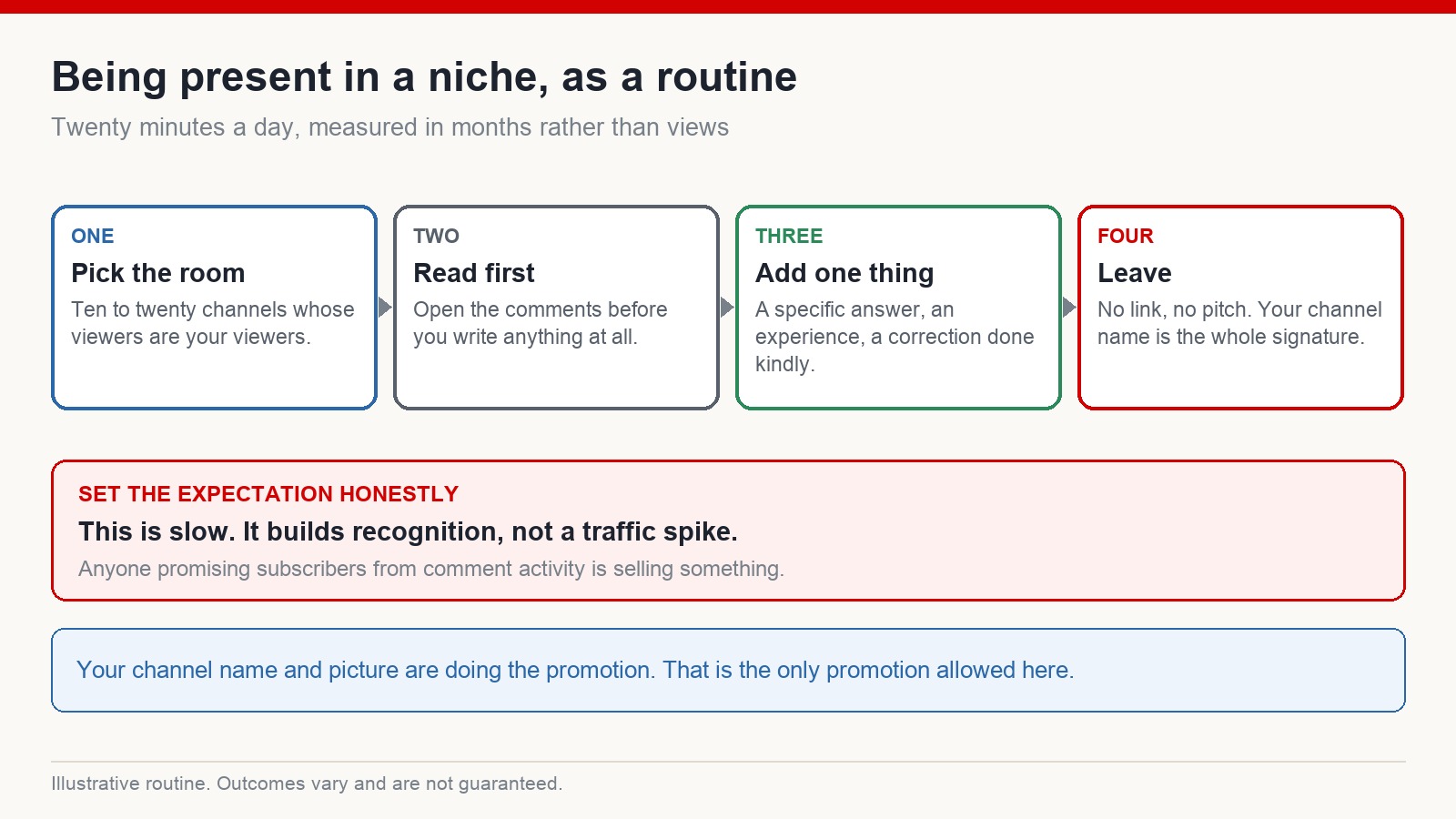
Pick the room. Ten to twenty channels whose viewers are plausibly your viewers. Not the biggest channels on the platform – the ones where a comment can still be seen. Under a video with four thousand comments, yours is not read by anyone.
Read before you write. Open the comments and look for the threads with actual discussion in them: an unanswered question, a disagreement, a place where the video skipped a step. Those threads have readers. A standalone comment at the bottom of a long list does not.
Add exactly one thing. An answer, an experience, a correction offered kindly, a detail the video left out. One useful contribution, written like a person. If you have nothing to add to a video, that is fine – not every video needs your comment.
Then leave. No link. No pitch. No “I made a video about this.” Your channel name and picture are the promotion, and they are enough. Anyone curious can click, and the ones who click after a genuinely good comment are worth ten who clicked a plug.
When someone asks what you do
Occasionally a reply comes back asking whether you have a channel, or where you learned something. Then you can answer directly, because you were asked. That is the only situation in which mentioning your own work belongs in someone else’s comment section, and it happens more often than you would expect once your comments are worth reading.
Do not engineer it. Comments written to bait that question read exactly like what they are.
If you are working in a language you do not speak
Running a channel for an English-speaking audience when English is not your first language makes this harder, and translation tools help – for understanding what a thread is actually about, checking that your phrasing is not accidentally rude, and catching grammar.
Two limits. Read the result and rewrite it in your own words, because a comment that reads as generated undoes the entire point of leaving one. And never automate the process across many videos: mass-generated comments are comment spam regardless of how good the individual sentences are.
What to expect, realistically
This does not produce a spike. On a good week it produces a handful of profile visits, a few of which become viewers, and one or two conversations with people who turn out to know more than you do about your own subject.
What it reliably produces is understanding. After a month of reading comment sections in your niche you will know which questions come up constantly, which explanations everyone gets wrong, and which topics are covered so thoroughly that there is no point adding to them. I have taken more video ideas out of other people’s comment sections than out of any research tool.
Anyone promising subscriber numbers from comment activity is selling something. Results vary, and most of the return here is not the traffic.
One thing that makes the clicks more likely
Since your channel name is doing all the promotion, it is worth it being clear. Readable, memorable, related to what you actually make, and not a near-copy of a larger channel in the same niche. A picture that survives being displayed at a small size helps too.
That is the whole of the optimisation. Everything else is writing comments worth reading.
Questions people ask
Is commenting on other channels in my niche against the rules?
No. Participating in discussions is normal use of the platform. Repetitive, automated or self-promotional commenting is what the spam policy covers.
Can I mention my channel if it is genuinely relevant?
Only if you were asked. Offering it unprompted, however smoothly, is the promotional comment the policy describes.
How many comments a day should I leave?
As many as you have something to say, which is usually a small number. A daily quota is how this turns into copy-paste.
Do bigger channels mind?
Creators generally like people who add something to their comment section and dislike people who use it as a billboard. You will be treated as whichever one you are.
Is it worth commenting on very large channels?
Rarely. Your comment is invisible under thousands of others. Mid-sized channels in your exact topic are where a comment still gets read.
The short version
Turn up in the places your audience already gathers, add something worth reading, and leave without a pitch. It is slow, it is not a traffic tactic, and it is one of the few forms of promotion that costs nothing and breaks no rules – because it is not really promotion at all.
If you want the rest of the process for building a faceless channel for an English-speaking audience, that is what we work through at mmoyoutube.com.